
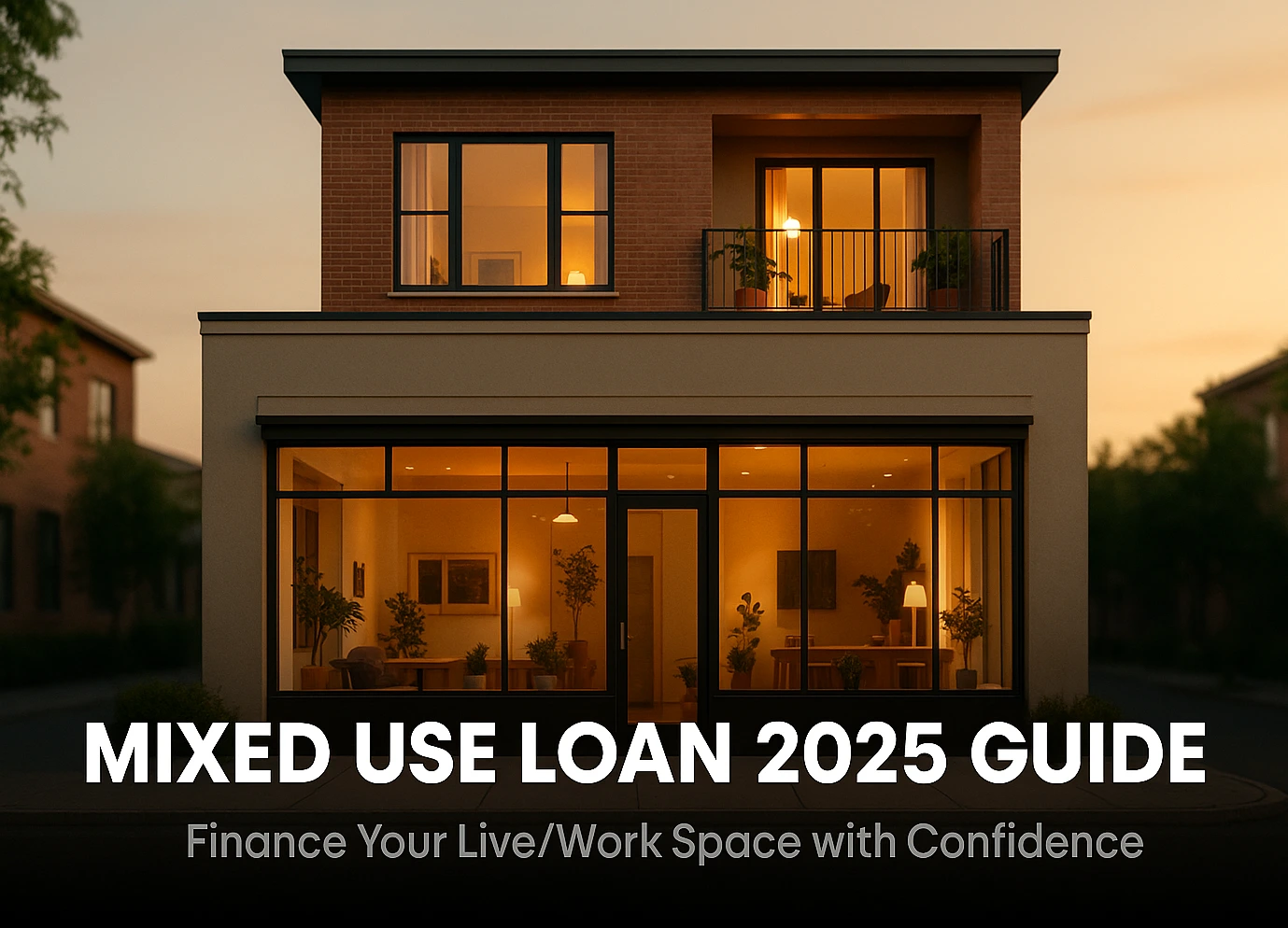
Dream of blending your home and business in one practical space? The rise of remote work and small businesses has made mixed-use properties—homes with a commercial component—more common. Enter the mixed use loan: a financing path designed for live/work buildings, from storefront homes to loft studios. This guide explains how these loans work with clear steps and examples. For broader options, see our guide to investment property loans.
Mixed-Use Loan Eligibility Checker
Use this tool to estimate your chances. Select your details for instant feedback. (For estimation only—consult a lender for official prequalification.)
This post contains affiliate links. If you buy through our links, we may earn a commission at no extra cost to you. Learn more.
Table of Contents
- What is a Mixed Use Loan?
- Success Stories
- Why Choose Live/Work?
- Property Types
- Key Factors
- Loan Options for Live/Work Financing
- Timeline & Documents
- Costs & Example Math
- Boost Approval Odds
- Why 2025 is Different
- FAQ
- Conclusion
What is a Mixed Use Loan?
A mixed use loan finances properties that combine living and working space under one roof. Lenders look at both your personal ability to repay (credit, income) and the property’s business side (rents, business plan). Many programs require at least 51% owner-occupancy and a 20–35% down payment, depending on the residential-to-commercial split. This structure lets you live over a shop, rent units above a café, or run an office from a loft with one loan.
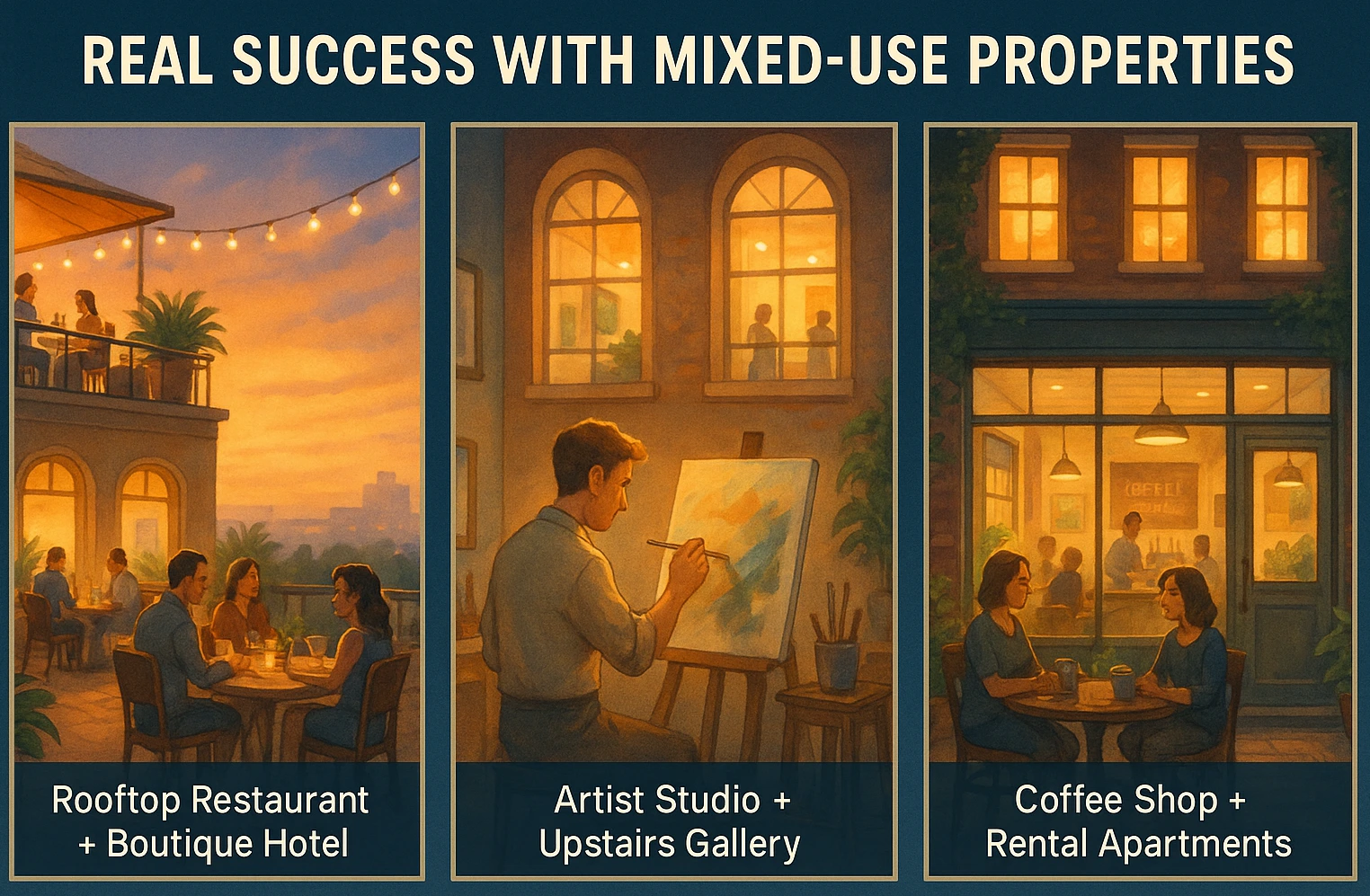
Success Stories: Real-Life Mixed-Use Projects
Case 1: The Urban Coffee Collective
A barista couple bought a $750,000 building with a café and two apartments. With 65% residential use and a DSCR of 1.38 from café profits and rent, they secured a conventional loan at 75% LTV. What helped most was a clear business plan and signed leases. The café now covers much of the payment while they live upstairs.
Case 2: The Artist’s Live/Work Loft
A graphic designer purchased a $1.1M loft with 40% studio space. Despite lower residential use, a 780 credit score and 1.30 DSCR qualified her for an SBA 7(a) loan at 80% LTV. The appraiser used income and cost approaches due to limited comps—showing why a mixed-use specialist matters.
Why Choose Live/Work?
Live/work financing can simplify life for entrepreneurs who want to cut commutes, diversify income, and build equity in one property. One loan can replace two separate mortgages, which may reduce paperwork and closing friction. Dual revenue—rents plus business income—can help you qualify for homes in better locations.
Beyond finances, mixed-use living adds convenience and community benefits. You save time, have close access to your business, and support walkable neighborhoods. These loans are ideal for:
- Flexibility: One property, one payment.
- Investment Potential: Two income sources can build equity faster.
- Convenience: Live where you work—no commute.
Property Types
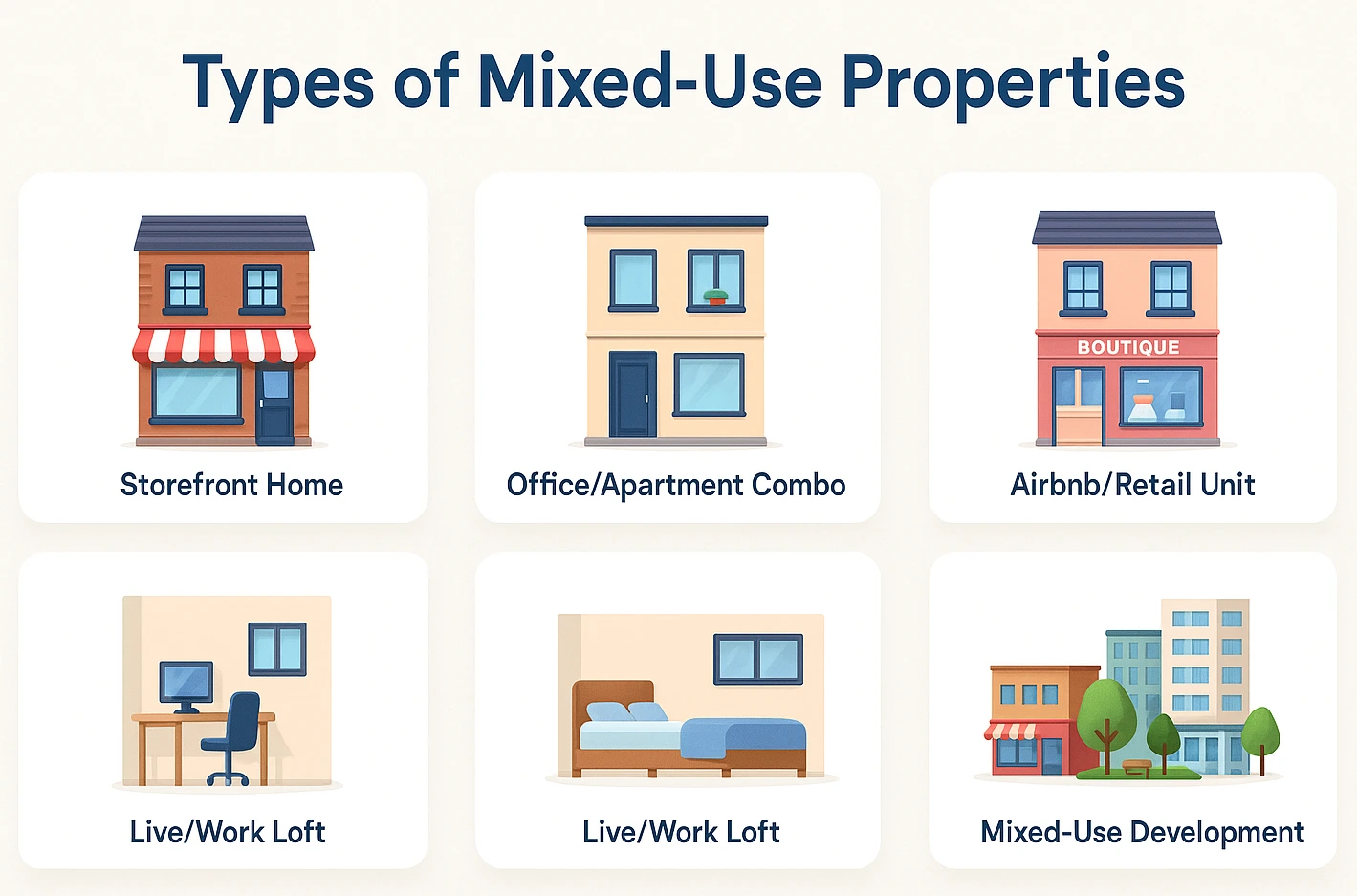
Common examples include:
- Storefront homes with Airbnb/retail: Ground-floor shop or café with living space or short-term rental above. Lenders will review STR rules and zoning.
- Office/loft combinations: Studios for design, therapy, or art paired with residential units. Strong personal income helps.
- Large mixed-use buildings: Retail, offices, restaurants, and apartments—often financed via commercial loans or SBA 504.
Key Factors in Live/Work Financing
Loan-to-Value & Reserves
Most lenders may cap LTV at 65–80%, which often means a 20–35% down payment. Higher residential use (around 70%+) can allow up to 80% LTV with friendlier pricing. Many lenders ask for 6–12 months of reserves to cover personal and property expenses during vacancies or slow seasons. Quick prequal checklist: confirm your use split (residential vs. commercial), estimate NOI from rents/business income, and verify that post-expense cash flow supports payments with a DSCR near 1.25. If you’re close but not there, look at trimming expenses, raising rents, or increasing your down payment to lower the loan amount.
Use Split, Income & DSCR
The residential vs. commercial percentage influences terms. If residential use is over 70%, you may see conventional-style pricing; with 60%+ commercial, expect more commercial-style rules. Lenders review personal income (W-2s, tax returns) and business performance (P&L, leases). A Debt Service Coverage Ratio (DSCR) near 1.25 is a common comfort point. Pro tip: show stabilized leases (even LOIs where appropriate), and include a brief business plan so underwriters understand demand, margins, and seasonality.
Appraisal, Zoning & Permits
Mixed-use appraisals can be complex when comparable sales are limited. Appraisers often blend sales, cost, and income methods—work with a hybrid-experienced appraiser. Zoning should explicitly allow both uses; variances take time and aren’t guaranteed. Secure permits, insurance (commercial + dwelling), and any needed HOA approval. Avoidable delays: missing zoning letters, outdated COs, or incomplete insurance binders are the most common last-minute holdups we see.
Rules and thresholds vary by lender and location. For personalized guidance, talk with a licensed mortgage professional and your local zoning office. See the official SBA 7(a) loan program page for owner-occupied financing basics.
| Factor | Typical | Stricter | Best-Case |
|---|---|---|---|
| LTV | 65–75% | 60–70% | Up to 80% |
| DSCR | 1.25+ | 1.15–1.24 | 1.40+ |
| Residential % | 51%+ | 40–50% | 70%+ |
| Reserves | 6 months | 12 months | 3 months |
| Credit Score | 660+ | 620–659 | 740+ |
Loan Options for Live/Work Financing
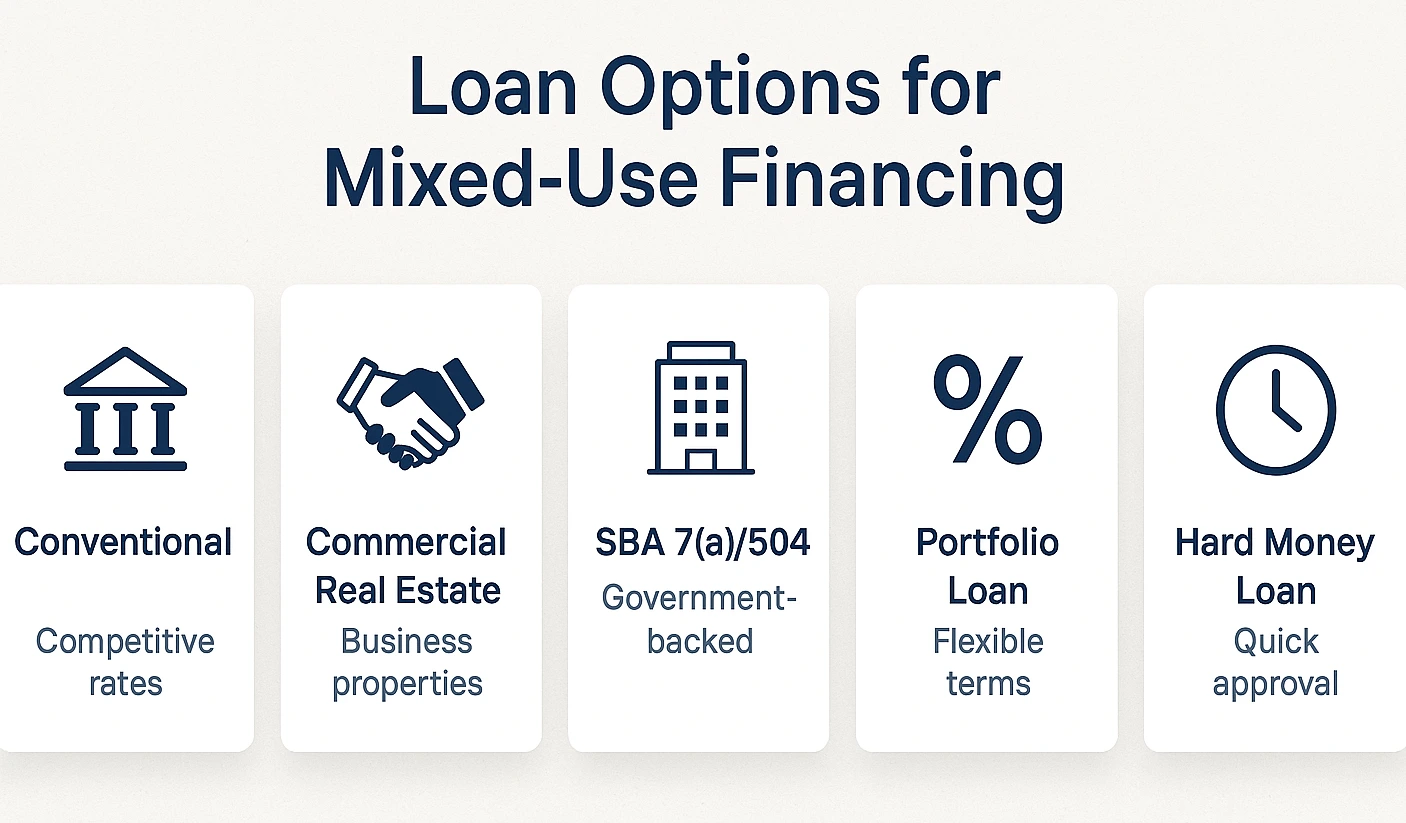
Several paths exist for mixed-use properties. Here’s a quick comparison:
| Loan Type | Best For | Down Payment | Rates | Term |
|---|---|---|---|---|
| Conventional | High residential (70%+), strong W-2 | 20–25% | Lower | 15–30 yrs |
| SBA 7(a)/504 | Owner-occupied business ≥51% | 10–20% | Low | 10–25 yrs |
| Commercial (CRE) | Heavier commercial use, strong DSCR | 25–35% | Higher | 5–10 yrs |
| Portfolio | Unique properties, local banks | 20–30% | Flexible | 5–20 yrs |
| Bridge/Hard Money | Rehab or quick close | 30%+ | Highest | 6–24 mos |
Which loan fits?
• Occupancy ≥51%? → Consider SBA 7(a) or 504 (owner-occupied).
• Residential ≥70% & strong W-2? → Conventional or portfolio.
• Heavier commercial & high DSCR? → CRE or DSCR lender.
• Need speed or rehab? → Bridge now, refinance later.
Timeline & Documents
From prequal to closing, plan for about 45–90 days:
- Prequalification: Share income, credit, and property basics (1–3 days).
- Term Sheet: Lender provides rates and terms (3–7 days).
- Appraisal & Inspection: Mixed-use specialist appraiser (2–4 weeks).
- Underwriting: Full document review and DSCR check (2–3 weeks).
- Conditions & Clearance: Final docs, zoning letter, insurance (about 1 week).
- Closing: Sign and fund.
Required docs: Personal tax returns (2 yrs), business P&L, leases, zoning compliance letter, business licenses, and insurance (commercial + dwelling).
Costs & Example Math
Assume an $800,000 mixed-use property (70% residential, 30% commercial). You put 25% down ($200,000) and finance $600,000 at 6.5% over 25 years.
- Monthly P&I: ~ $4,050
- Commercial rent: $3,000/mo → NOI: about $2,500 after expenses
- DSCR: $2,500 ÷ $4,050 = 0.62 → too low for many lenders
Rate/payment scenarios: If your rate drops to 6.0%, P&I is roughly $3,599—DSCR rises if NOI holds. If NOI increases to $5,100, DSCR would be ~1.42 at the original payment. You can move the needle by: (1) negotiating rent escalators, (2) cutting variable expenses, and (3) reducing leverage (bigger down payment or seller credits). Try scenarios in our Mortgage Calculator.
Boost Approval Odds
- Improve credit (aim 660+): fix errors, pay down balances.
- Target 25%+ down—often improves pricing.
- Build a 12-month business plan with revenue projections.
- Gather two years of tax returns, P&L, and leases.
- Choose a lender experienced in owner-occupied and hybrid properties.
- Hire a mixed-use appraiser early.
- Verify zoning and permits before applying.
- Negotiate—ask about buydowns or reduced fees.
Common pitfalls: Don’t assume standard appraisals work—comps can be scarce. Don’t skip zoning verification—variances may take months. Don’t ignore short-term rental rules—many lenders limit them.
Why 2025 is Different
Demand for live/work spaces continues to grow in 2025 with hybrid work and neighborhood revitalization. Lenders are speeding up digital underwriting and, in some cases, encouraging energy-efficient upgrades. Expect a mix of SBA and portfolio products that can suit creative and service businesses.
- Energy incentives: Some lenders offer perks for efficiency upgrades.
- Digital tools: Virtual appraisals and e-closings can shorten timelines.
FAQ
Conclusion
Mixed-use can be a smart way to live close to your work while building equity from more than one income stream. The right loan depends on how your space is split, your credit profile, and the strength of your business or rental income.
Start by clarifying your use mix and documents, then compare one or two lender types that fit your scenario—often SBA for owner-users, conventional or portfolio when residential use is higher, or CRE when the commercial share dominates. When you’re ready, run the eligibility checker above and map your next step.
Educational content only—this isn’t legal, tax, or financial advice. Loan terms, rates, and eligibility vary by lender and may change without notice. Always verify zoning, occupancy, permits, insurance, and licensing with your local authorities and lender before applying. Examples are illustrative; outcomes depend on your profile and property.