

A short term rental loan gives investors fast capital to buy, renovate, or refinance Airbnb and VRBO properties when traditional mortgages move too slowly. This 2025 guide covers loan types, approval criteria, typical rates, and risk traps so your deal cash-flows from day one. For broader financing options, see our pillar on investment property loans.
This post contains affiliate links. If you buy through our links, we may earn a commission at no extra cost to you. Learn more.
Table of Contents
- Pros and Cons of Short Term Rental Loans
- Types of Short Term Rental Loans
- Loan Strategy Chart
- Avoiding Risks in Short Term Rental Financing
- Term Sheet Red-Flag Translator
- DSCR Quick Check
- Exit Strategy Blueprint
- Due Diligence for Vacation Rental Loans
- 2025 Trends in Short Term Property Loans
- Frequently Asked Questions
- Conclusion
Pros and Cons of Short Term Rental Loans
Short term rental loans can close in 1–4 weeks and may qualify based on property cash flow. That speed helps with time-sensitive Airbnb deals and fixer-uppers often funded via bridge loans or hard money. However, rates often fall around 8–15%, origination fees 2–5 points, and terms rarely exceed 36 months, so you’ll want a clear exit.
Rates, points, leverage, and timelines are illustrative and vary by lender, market, and borrower profile. Always compare written term sheets.
Key advantages: speed, flexibility, renovation funding. Key drawbacks: high cost, short term, strict exit.
Types of Short Term Rental Loans (Bridge Loans)
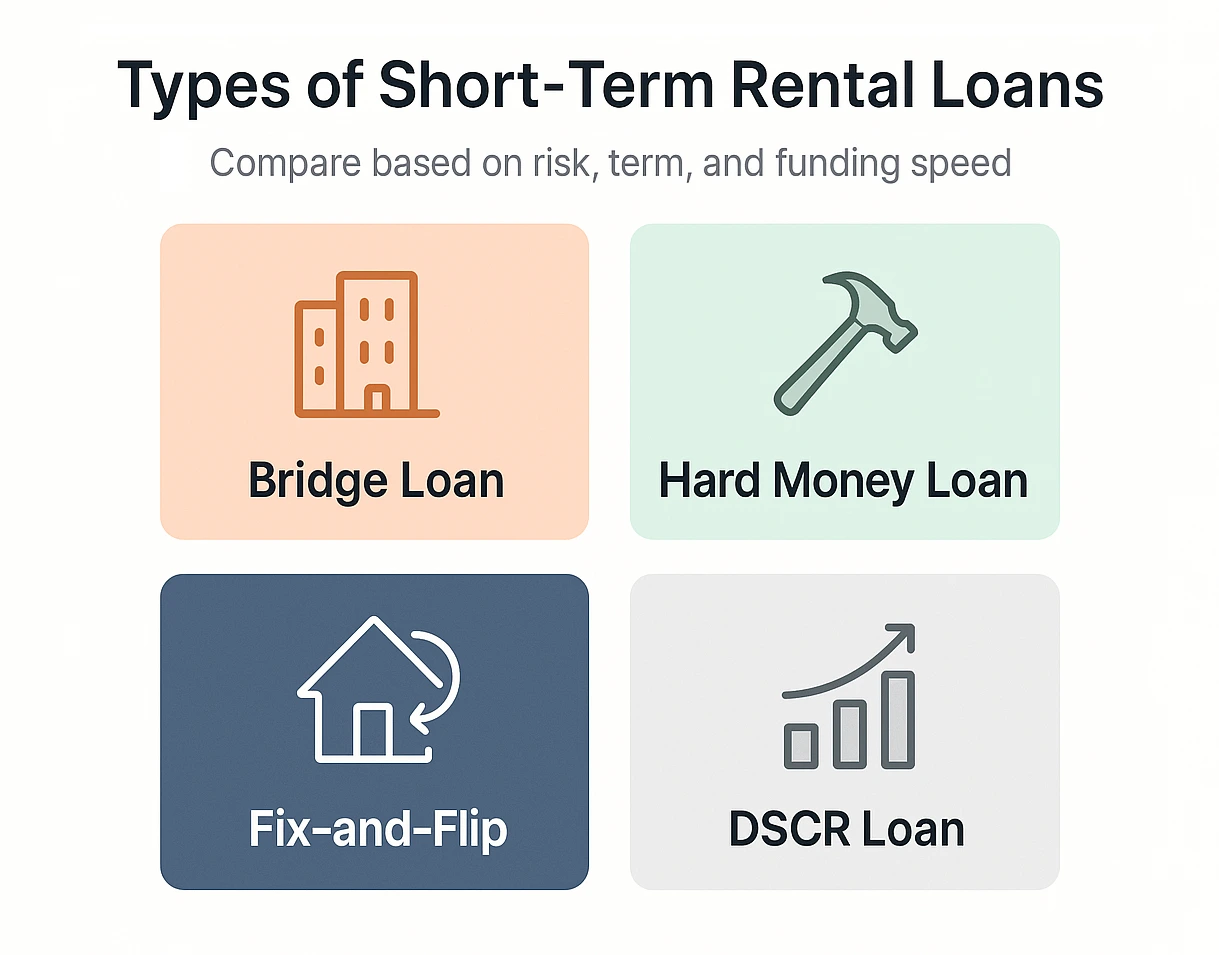
Four core products dominate the 2025 market. Each includes purpose, term, funding speed, cost, LTV/LTC, collateral, best fit, and required exit.
1. Bridge Loans
Bridge loans fund acquisition or renovation while you sell an existing asset or secure long-term financing. Term: 1–12 months. Funding: 3–10 days. Cost: 8–12% + 2–4 points. Max LTV/LTC: 75% purchase, 100% rehab. Collateral: first lien on subject property (as-is value). Best for investors with a pre-approved refi or buyer. Exit: refinance or sale required at maturity.
2. Hard Money Loans
Hard money loans are asset-based and secured by after-repair value, helpful for distressed properties. Term: 6–24 months. Funding: 7–14 days. Cost: 10–15% + 3–5 points. Max LTV/LTC: 65% ARV, 100% rehab. Collateral: first lien (ARV appraisal). Best for experienced flippers. Exit: sale or refi; default risks foreclosure.
3. Fix-and-Flip Loans
Fix-and-flip loans cover purchase plus full renovation for resale or conversion to rental. Term: 6–18 months. Funding: 7–21 days. Cost: 9–14% + 2–4 points. Max LTV/LTC: 70% ARV, 100% rehab. Collateral: first lien (draw schedule). Best for contractors with detailed scope. Exit: sell at completion; market risk applies.
4. Short-Term DSCR Loans
Short-term DSCR loans qualify primarily on rental income (NOI ÷ debt service ≥ 1.2). Term: 12–36 months. Funding: 14–30 days. Cost: 7–11% + 1–3 points. Max LTV: 75%. Collateral: first lien (income appraisal). Best for cash-flowing assets. Exit: refi to 30-year DSCR or conventional.
Real-World Example
Say you’re eyeing a small cabin listed at $320,000 that needs $35,000 in work. A bridge lender offers 75% of purchase plus 100% of rehab with a 9-month term at 10% and 3 points. You bring ~$80,000 to close (down + fees) and set aside a small reserve. After a light remodel and pro photos, average nightly rate climbs from $135 to $175 with 70% occupancy. Your interest-only payments are covered, but your DSCR sits around 1.15—close to most lenders’ 1.2 threshold. With an extra $20/night or modest expense cuts, you can refi to a 30-year DSCR loan and retire the bridge debt before month nine.
Loan Strategy Chart
| Loan Type | Funding Speed (Fastest?) | Risk Level (Lowest?) | Cost Level (Highest?) | Best Fit |
|---|---|---|---|---|
| Bridge Loan | Yes | No | Yes | Transition deals with confirmed exit |
| Hard Money Loan | Yes | No | Yes | Distressed fix-and-flips |
| Fix-and-Flip Loan | Yes | No | Yes | Full rehab projects |
| Short-Term DSCR Loan | Maybe | Yes | Maybe | Cash-flow rentals |
Avoiding Risks in Short Term Rental Financing
Five common traps can threaten profitability. Spot them early and compare alternatives.
1. Appraisal & Income Inflation
Lenders may overstate ARV or projected rent to justify a larger loan. Compare any appraisal to recent comps and use AirDNA at 70% occupancy max.
2. Hidden Costs
Prepayment penalties, admin fees, and draw inspection charges may hide in fine print. Request a full fee breakdown and compare it to your Loan Estimate and Closing Disclosure.
3. Balloon & Cross-Collateral
Balloon payments force refinance at maturity; cross-collateral can risk multiple assets. Avoid both unless your exit is documented and time-bound.
4. Rate & Term Mismatch
Rates above 15% or terms under 6 months rarely pencil. Shop three lenders and negotiate points down.
5. Lack of Transparency
Vague draw schedules or shifting terms signal trouble. Walk if disclosures are unclear. If you publish reviews or recommendations, follow the FTC’s endorsement & disclosure guidance.
Term Sheet Red-Flag Translator
| Term | Means | Risk | Counter-Ask |
|---|---|---|---|
| Points | Upfront fee (1 point = 1% of loan) | Cuts net proceeds | Cap at 3; negotiate down |
| Prepay Penalty | Fee to pay early | Limits flexibility | Waive or limit to 6 mo |
| Cross-Collateral | Multiple properties secure one loan | Broader loss risk on default | Prefer single-asset collateral |
| Interest Reserve | Lender holds payments in escrow | Reduces cash flow | Minimize or fund yourself |
| Recourse | Personal guarantee | Personal assets at risk | Push for limited/non-recourse carve-outs |
DSCR Quick Check
DSCR = NOI ÷ annual debt service. Many lenders look for ≥ 1.2 using conservative income and expense assumptions.
Example (interest-only): $150 nightly × 70% occupancy × 365 = $38,325 gross. Minus 30% expenses/vacancy = $26,828 NOI. Loan $300k @ 9% (interest-only) ≈ $27,000 annual debt. DSCR = 0.99 → fails. Consider raising rent, improving occupancy, or lowering the loan amount.
| Income Swing | DSCR |
|---|---|
| +10% rent | 1.09 |
| Base | 0.99 |
| -10% rent | 0.90 |
Exit Strategy Blueprint
Short-term debt only works when the exit is locked. Use this simple plan to reduce risk before you close.
- Pre-qualify your refinance early. Start rate quotes and eligibility checks as soon as you’re under contract. Ask lenders what DSCR, LTV, reserves, and seasoning they’ll require at take-out. Save written term sheets so you can pivot if one lender says no.
- Build a time-buffered schedule. Map inspection, rehab, furnishing, and photos on a calendar with at least two weeks of slack for supply delays or contractor slippage. If your bridge term is nine months, aim to list or refi by month six.
- Protect cash flow. Keep three to six months of payments in reserve (or an interest reserve on the loan). Line up a backup disposition—list at 95% of projected ARV or open long-term leasing as a fallback—so you’re not forced into an expensive extension.
Treat extensions as a last resort and confirm their fee structure in writing. A modest rent lift or expense trim that nudges DSCR from 1.15 to 1.25 can be the difference between approval and denial.

Due Diligence for Vacation Rental Loans
Run lender background checks, compare at least three offers, and verify local STR rules before signing. Collect: 2 months bank statements, rehab budget with contractor bids, AirDNA comps or a 12-month pro forma, entity documents, and a short-term rental insurance quote.
2025 Trends in Short Term Property Loans
Automation can shorten approvals while cities tighten zoning and permit caps. Some lenders weigh third-party rental data more heavily and may cap LTV around 70% in high-regulation markets. States keep updating how they tax short-term rentals—see this NCSL overview for context. Expect niche products for eco-retrofits and unique stays.
Frequently Asked Questions
Conclusion
A short term rental loan delivers speed and flexibility but demands discipline on cost, cash flow, and exit. Use the spec blocks, red-flag translator, and DSCR check above to vet any offer. Stress-test your deal with our mortgage calculator before you sign.
Educational content only—this is not legal, tax, or financial advice. Lending terms and regulations for short-term rentals vary by city and lender and change frequently. Verify zoning, permits, occupancy limits, and local tax rules before applying. Always review a lender’s disclosures and consult a qualified professional about your situation.