
Real-estate financing can feel overwhelming—especially when lenders focus on your personal income. If you’re an investor looking to acquire or refinance a rental property, understanding the DSCR loan meaning can help you qualify with confidence. To dive deeper into this financing option, explore our comprehensive guide on dscr loan explained.
For first-time investors, beginner real estate investors, or small business owners, grasping DSCR loans is essential. Unlike conventional loans that scrutinize W-2s, tax returns, and debt-to-income ratios, DSCR loans focus on the property’s income. They ask: Can the rental property cover its debt payments?
This guide demystifies DSCR loans, breaks down their components, explains calculations with examples, and helps determine if they fit your goals. Unlock a financing alternative designed for savvy investors.
Try the DSCR calculatorIn one sentence: A DSCR loan is a mortgage where the property’s cash flow—not your personal income—must comfortably cover the loan’s payments.
This post contains affiliate links. If you buy through our links, we may earn a commission at no extra cost to you. Learn more.
Table of Contents
- What Does DSCR Stand For?
- DSCR Loan Meaning Explained
- How is the DSCR Calculated?
- DSCR Calculation Examples
- Why Does the DSCR Matter for Lenders?
- What is a Good DSCR?
- Advantages of DSCR Loans
- Drawbacks of DSCR Loans
- Who Should Consider a DSCR Loan?
- Who Might Not Benefit?
- Preparing for a DSCR Loan Application
- Cash-Flow Ratio Calculator
- Frequently Asked Questions
- Conclusion
What Does DSCR Stand For?
Before diving into what a DSCR loan means, let’s define the acronym.
Debt Service Coverage Ratio
The Debt Service Coverage Ratio measures a property’s ability to cover debt with its income. It’s a financial health check focused on cash flow, central to the DSCR loan. A higher ratio reassures lenders. Learn more at Investopedia’s DSCR page.
DSCR Loan Meaning Explained
Key Qualification Criteria (DSCR loan requirements)
A DSCR loan is a mortgage for income-producing properties, like 1-4 unit rentals or multifamily buildings. The loan’s hallmark is its focus on the property’s Debt Service Coverage Ratio, not personal income. Most lender requirements for DSCR loans center on whether the property’s cash flow can comfortably cover projected debt payments.
Lenders assess if the property’s rental income covers mortgage payments (principal, interest, taxes, and insurance (PITI)). If income exceeds debt, you may qualify, even with complex finances, making it ideal for investors.
How is the DSCR Calculated?
Understanding DSCR loans starts with the calculation. Lenders use a formula to determine the property’s DSCR:
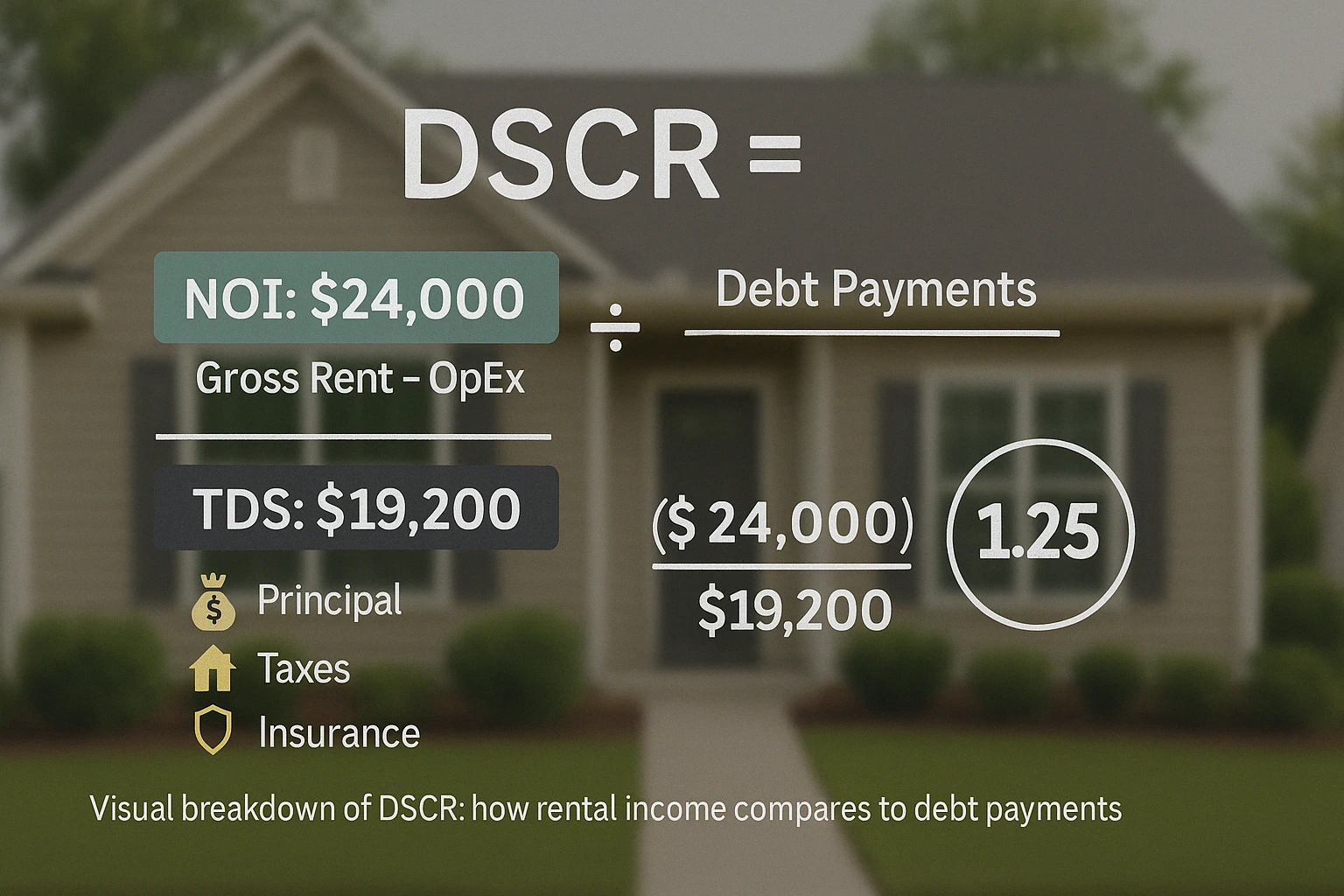
DSCR = Net Operating Income (NOI) / Total Debt Service (TDS)
Here’s a breakdown to clarify:
Net Operating Income (NOI)
NOI is the property’s profit before financing costs, central to DSCR lending. It’s calculated as:
- Gross Rental Income (GRI): Total annual rent if fully occupied, based on leases or market estimates.
- Vacancy Allowance: Subtract 5-10% of GRI for potential vacancies.
- Effective Gross Income (EGI): GRI minus Vacancy Allowance.
- Operating Expenses (OpEx): Costs like taxes, insurance, management, maintenance, utilities, and HOA dues.
Note: NOI excludes mortgage payments, depreciation, taxes, and capital expenditures.
NOI = EGI – OpEx
2. Total Debt Service (TDS)
TDS is the annual debt payments, primarily the mortgage.
- Principal & Interest (P&I): Yearly loan payments based on amount, rate, and amortization.
- Taxes & Insurance (T&I): Often included as PITI, depending on the lender.
TDS = Annual P+I (+ Taxes + Insurance, if included)
DSCR = (Gross Rental Income – Vacancy Allowance – Operating Expenses) / (Annual P+I + Taxes + Insurance)
DSCR Calculation Examples
Let’s illustrate the ratio with practical examples:
Scenario 1: Property with Positive Cash Flow
Property: Single-family rental
- Purchase Price: $300,000
- Down Payment (25%): $75,000
- Loan Amount: $225,000
- Interest Rate: 7.0% (30-year fixed)
- Monthly P&I: $1,496.94 (Annual P&I = $17,963.28)
- Monthly Rent: $2,800 (Annual Gross Rental Income = $33,600)
- Annual Property Taxes: $3,600
- Annual Insurance: $1,200
- Vacancy Allowance (5%): $1,680 ($33,600 * 0.05)
- Annual Operating Expenses (Maintenance, Management): $5,088 ($2,400 maintenance + $2,688 management [8% of EGI])
Calculations
- Effective Gross Income (EGI): $33,600 – $1,680 = $31,920
- Operating Expenses (OpEx): $3,600 (Taxes) + $1,200 (Insurance) + $5,088 (Maint/Mgmt) = $9,888 (Note: Taxes and Insurance included in OpEx for NOI, but separated for DSCR).
- NOI (excluding T&I): $31,920 – $5,088 = $26,832
- Total Debt Service (TDS – PITI): $17,963.28 + $3,600 + $1,200 = $22,763.28
- DSCR Calculation:
- NOI = $26,832
- TDS = $22,763.28
- DSCR = $26,832 / $22,763.28 = 1.18
Interpretation: This property’s DSCR of 1.18 means its income is 1.18 times the debt service, a positive sign for lenders. Some may require a higher ratio (e.g., 1.25).
Scenario 2: Property with Break-Even or Negative Cash Flow
Property: Single-family rental
- Annual Gross Rental Income (GRI): $26,400
- Vacancy Allowance (5%): $1,320 ($26,400 * 0.05)
- Effective Gross Income (EGI): $26,400 – $1,320 = $25,080
- Operating Expenses (Maint/Mgmt): $4,500
- NOI (excluding T&I): $25,080 – $4,500 = $20,580
- Total Debt Service (TDS – PITI): $22,763.28
DSCR Calculation
DSCR = $20,580 / $22,763.28 = 0.90
Interpretation: A DSCR of 0.90 shows the property’s income doesn’t cover debt, making it unlikely to qualify for a standard DSCR loan.
These examples show how rent and expenses drive the ratio. Accurate projections are critical.
Why Does the DSCR Matter for Lenders?
DSCR-centered lending emphasizes risk assessment. To explore which lenders prioritize this metric, check out our guide on the best DSCR lenders for 2025:
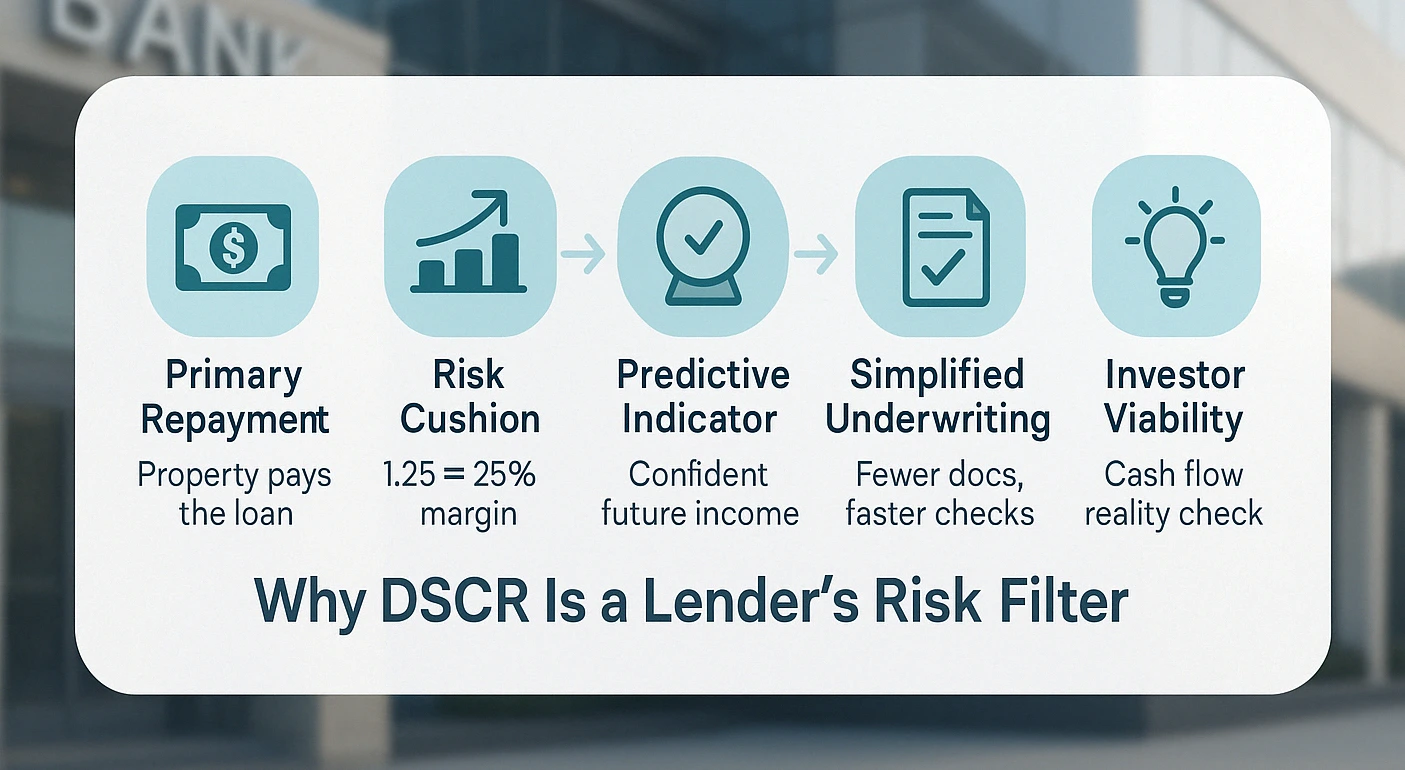
- Repayment Source: The property is the primary repayment source, not personal income.
- Risk Assessment: A DSCR above 1.0 offers a safety cushion against vacancies or downturns.
- Predictive Indicator: A strong DSCR signals ongoing debt service ability.
- Simplified Underwriting: Focusing on DSCR can streamline approval for complex incomes.
- Investor Viability: Ensures the property is a sound investment.
What is a Good DSCR?
A “good” DSCR varies by lender, but here’s a guideline for how lenders view it:
- DSCR < 1.0: Unacceptable; income doesn’t cover debt.
- DSCR = 1.0: Break-even; too risky for most lenders.
- DSCR > 1.0 (1.01 – 1.19): Borderline; may face stricter terms.
- DSCR ≥ 1.20 / 1.25: Good to excellent, yielding better terms.
Factors influencing requirements: Lender appetite, property type, loan-to-value, credit score, local market conditions, and prevailing rates all play a role. Lower LTV or stronger credit can offset a slightly lower ratio.
Advantages of DSCR Loans
DSCR loans offer unique benefits for investors:
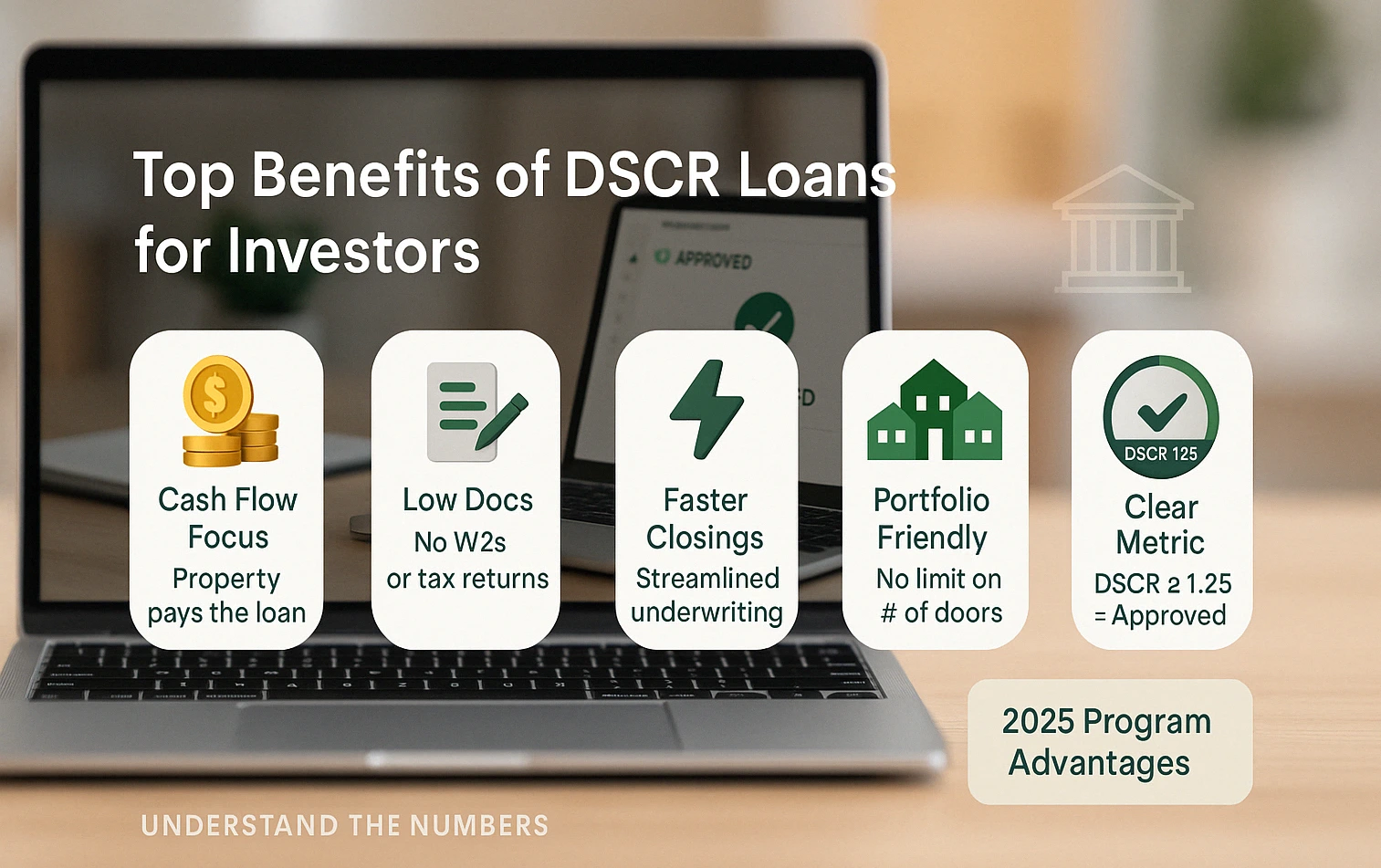
- Property Focus: Ideal for cash-flowing properties, even with complex income.
- Minimal Income Verification: Many lenders don’t require W-2s or tax returns for DSCR programs, though requirements vary by lender.
- Faster Closing: Less documentation can speed up the process.
- Unlimited Properties: Often no cap on financed properties.
- Entity Borrowing: Loans can be made to LLCs.
- Clear Metric: DSCR simplifies qualification.
Drawbacks of DSCR Loans
Consider these drawbacks of DSCR loans. Compare rates using our real estate tools section:
- Higher Rates: Non-QM loans have higher interest rates.
- Larger Down Payments: Expect 20–30% minimum.
- Appraisal Emphasis: Low rent estimates can impact approval.
- Prepayment Penalties: Common for early payoff.
- Investment Only: Not for primary residences.
- Cash Flow Requirement: Properties must generate strong income.
Who Should Consider a DSCR Loan?
DSCR loans suit specific investors. For those investing in short-term rentals, explore our guide on short-term rental loans for related financing options:
- Experienced Investors: Scaling portfolios beyond conventional limits.
- Self-Employed: Those with complex income documentation.
- High DTI Borrowers: Investors with personal debt but cash.
- Foreign Nationals: Some programs cater to non-US residents.
- Entity Borrowers: Using LLCs or corporations.
- Speed Seekers: Prioritizing simpler qualification.
Who Might Not Benefit?
These loans aren’t ideal for owner-occupied homes, heavy-renovation projects, borrowers who could qualify for lower-cost conventional financing, or anyone needing minimal down payments.
Preparing for a DSCR Loan Application
Analyze & calculate: Estimate realistic market rents and typical expenses, then aim for a DSCR of about 1.20+ using the calculator below. This helps you spot shortfalls early and adjust strategy before you’re under contract.
Documents & credit: Pull together leases, rent rolls, or P&L statements to support income. Check your credit (a 660+ score often improves pricing) and correct any errors so underwriting moves faster.
Funds, entity & shopping lenders: Line up your down payment and reserves (often 3–6 months of PITI). If borrowing via an LLC, have formation and operating agreement ready. Then compare lenders—their DSCR minimums, prepay penalties, and rates differ.

DSCR Calculator
Use this quick DSCR calculator to estimate the ratio for your property. Enter details or use example values to see guidance and resources. Visit our real estate tools section for more.
(For estimation only. Consult a lender for official calculations.)
Frequently Asked Questions
Conclusion
Understanding DSCR helps investors finance rental properties based on cash flow, not personal income. By focusing on the Debt Service Coverage Ratio, these loans offer flexibility for complex financial situations. Use our real estate tools section to calculate your DSCR and start your investment journey today.
Disclaimer: This article is for education only and isn’t legal, tax, or financial advice. Loan programs and underwriting standards vary by lender and market. Always confirm requirements and pricing with a licensed mortgage professional. Calculator results are estimates, not offers.