

Struggling to finance your first rental in 2025’s tricky market? Imagine owning a cash-flowing property that supports your goals—from a cozy Airbnb to a small apartment building. With 2025 bringing tighter rules and new opportunities, securing investment property loans requires a sharper strategy. Unlike buying a home to live in, financing a rental involves higher stakes, stricter criteria, and unique loan options. Many searches start with sticker shock over 20%+ down—here’s how to work around it without wrecking cash flow.
Which Loan Type Suits You? Quick Quiz
Three quick questions. See a tailored loan suggestion—then tweak and retry.
What’s your investment goal?
Your Best Loan Match
This post contains affiliate links. If you buy through our links, we may earn a commission at no extra cost to you. Learn more.
Table of Contents
- Why Investment Property Loans Differ in 2025
- Types of Rental Property Loans: Find Your Fit
- Quick Investor Personas
- Loan Type Comparison Table
- How Lenders Assess You (2025)
- Down Payment Strategies
- Rates & Costs in 2025
- Niche Plays & Special Considerations
- Application Process
- Common Pitfalls to Avoid
- Frequently Asked Questions
- Your Path to Rental Property Financing Success
Why Investment Property Loans Differ in 2025
Owner-occupied mortgages are built around your need for housing. Investment property loans focus on whether the property can reliably pay its own way—rents, expenses, and reserves. In 2025, lenders lean on AI-driven property analytics, consider short-term rental income where local rules allow, and show renewed appetite for mixed-use in walkable areas. Rate volatility means you should model base and downside cash-flow cases with buffers. If easing occurs later in 2025, some conventional quotes may hover in the mid-6% to mid-7% range—always verify current pricing and stress test the deal.
How They Differ from Home Mortgages
Expect higher down payments (often 15–30% vs. as low as 3% for primary homes), stricter credit (700+ common; best pricing at 740+), rates typically 0.5–1.0% above owner-occupied, heavier emphasis on property income metrics like DSCR, and 3–6 months of PITI reserves after closing.
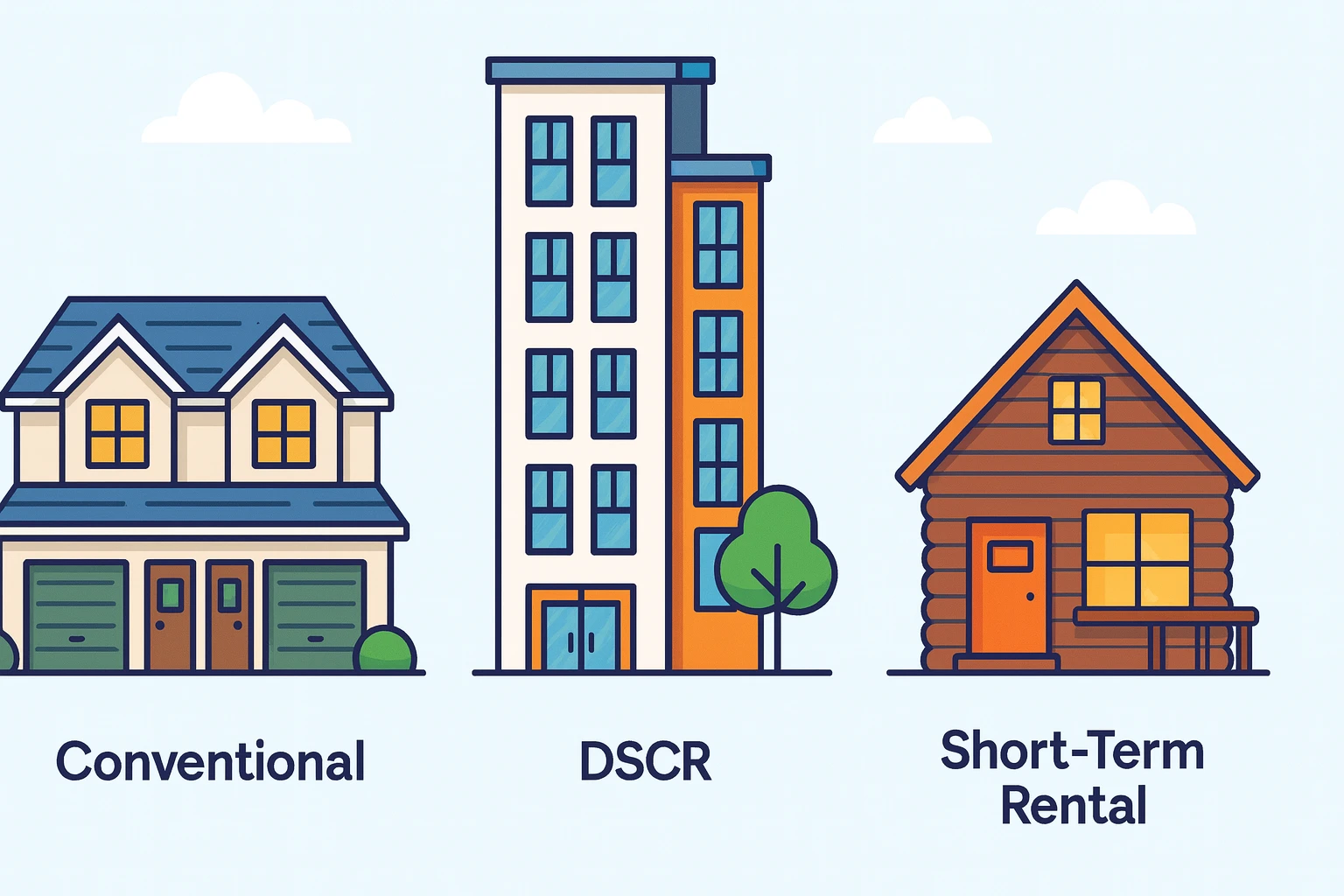
Types of Rental Property Loans: Find Your Fit
Now that we’ve mapped the landscape, let’s narrow the loan type that fits your strategy. Below are four grouped categories to keep choices clear and practical.
Traditional vs. Income-Based (Conventional & DSCR)
Conventional loans (1–4 units) offer competitive pricing and predictable terms but usually require 15–30% down and tighter DTI limits, rewarding 740+ credit. DSCR (Debt Service Coverage Ratio) loans focus on the property’s ability to pay: DSCR = NOI ÷ debt service (PITI), with ≥1.25 a common target. Example: if monthly NOI is $3,000 and PITI is $2,000, DSCR = 1.5—typically strong. DSCR can suit short-term rentals or self-employed borrowers when the property cash flows. If you plan to operate nightly rentals, this guide to Airbnb loan requirements explains how lenders evaluate hosts and projected income. Some lenders package short term rental loans specifically for nightly rentals; compare those terms with DSCR offers.
Case study—Sarah’s cabin: A $400,000 purchase with projected $4,000 revenue and $1,200 expenses yields $2,800 NOI. With $2,000 PITI, DSCR = 1.4—sufficient for many DSCR lenders, paired with 20–25% down and adequate reserves. For broader options tailored to hosts, see a concise overview of short term rental loans and the documentation most lenders expect.
Fast-Track Capital (short term property loans, Hard Money & Private)
Hard money and private loans trade price for speed and flexibility. Underwriting can emphasize after-repair value (ARV) and experience, with closings in days and terms of 6–24 months. These products can carry higher rates/fees and require crisp scope, budget, and exit plans—perfect for flips or heavy rehabs when the clock matters more than cost. If timing is crucial, compare structures typical of short-term property loans for bridge scenarios—many lenders also brand these as short term property loans when speed is the priority.
Scaling Up (Commercial & Portfolio)
Commercial loans (5+ units/mixed-use) center on NOI, occupancy, and management strength, often requiring 25–40% down and sometimes balloon structures. Portfolio loans stay on a lender’s books, enabling flexible guidelines for non-traditional situations (unique properties, complex incomes) at somewhat higher pricing than agency options. If you’re evaluating a hybrid asset, start with a plain-English overview of a mixed-use loan and how banks split residential vs. commercial income. If you’re weighing a mixed use loan, ask how the lender allocates NOI between the storefront and the apartments.
Leverage & Live-In Paths (HELOC/Cash-Out & Gov-Backed)
Using a HELOC or cash-out refinance on existing equity can seed down payments at relatively low cost—just weigh the risk of encumbering your residence. FHA/VA primarily serve primary residences; FHA can apply to 1–4 units if you live in one. Misrepresenting occupancy intent is fraud—house-hack legally or choose non-owner-occupied products. For 1–4 unit buildings with storefronts or workspaces, you may also encounter mixed-use mortgage frameworks with unique underwriting quirks; many banks simply call this a mixed use mortgage.
Quick Investor Personas
The Beginner Landlord: House-hacks a duplex; explores FHA for low down if living in one unit, then plans to roll equity into the next buy.
The Airbnb Pro: Targets high-demand STR markets; models DSCR with seasonality and compliance checks; builds reserves for off-season dips. If a permit is required, pre-qualify with a lender that supports a short term rental loan application so projected income can be counted correctly.
The Flip Specialist: Prioritizes time-to-close; uses hard money with tight ARV comps and a contractor bid, exits via sale or DSCR refi.
Loan Type Comparison Table
| Loan Type | Down Payment | Interest Rate | Best For |
|---|---|---|---|
| Conventional | 15–30% | 6.5–7.5% | Long-term rentals |
| DSCR | 20–25% | 7–8.5% | Income-focused scenarios |
| Portfolio | 20–30% | 7–9% | Non-traditional borrowers |
| Hard Money | 25–35% | 8–15% | Fix-and-flip speed |
| Commercial | 25–40% | 6.5–8% | 5+ units, mixed-use |
| FHA (Owner-Occupied) | 3.5–10% | 6–7% | Live-in small multifamily |
How Lenders Assess You (2025)
Credit: Many lenders look for 700+ FICO, with best tiers at 740+. Improve by paying on time, keeping revolving utilization under ~30%, and avoiding new debt before closing.
Financial health: Conventional often targets DTI ≤43% and 3–6 months of PITI reserves (more for multi-property investors). Example: $2,000 monthly debts ÷ $6,000 gross income = 33% DTI.
Property underwrite: Expect scrutiny of rent comps, vacancy assumptions, operating expenses, and location risk. Prepare a clean pro forma and supporting market data to speed decisions. For hybrid assets, get familiar with practical steps in mixed-use property financing so documentation aligns with lender expectations. Understanding mixed use property financing criteria up front helps prevent appraisal and underwriting delays.
Down Payment Strategies
Savings: Automate transfers to a dedicated fund and sustain stable balances for 60–90 days before underwriting.
Home Equity: A HELOC or cash-out can fund 20–25% down at relatively low cost; assess the risk to your residence and cash-flow buffers.
Partnerships: Share equity and roles via an attorney-drafted operating agreement that defines capital calls and exits.
Seller Financing: Occasionally viable—negotiate partial carrybacks or short interest-only periods to bridge gaps.
Self-Directed IRA: Possible through specialist custodians; understand prohibited transactions and tax implications before proceeding.
Tip: Create a lender-ready one-pager: price, rent comps, pro forma, DSCR snapshot, liquidity, experience. It speeds pre-screens and keeps quotes apples-to-apples.
Case study—Mike’s equity play: A $100,000 HELOC covered 25% down on a $400,000 duplex, supporting a conventional approval with reserves intact.
Case study—Jamal’s 6-unit: A $1.0M purchase underwrote to $78,000 NOI and ~$60,000 annual debt service (DSCR ≈ 1.3). With 30% down and six months’ reserves, a commercial lender cleared the file, aided by strong management and a conservative rent roll. If you’re assembling comps and statements for a bank package, skim this overview of a mixed-use property loan to anticipate typical asks. This mirrors many steps in the loan process for mixed-use assets.
Rates & Costs in 2025
Rates for investment property loans are usually higher than for primary homes. In 2025, many solid conventional files may see mid-6% to mid-7% ranges, with DSCR pricing typically higher. Outcomes depend on credit, LTV, property type, and market conditions—always check current quotes. For broad context across fixed-rate benchmarks, see the Freddie Mac Primary Mortgage Market Survey.
Tip: Cross-check PMMS with a same-day quote from multiple lenders, or use CFPB’s Explore interest rates tool to see how credit score and down payment affect rates.
Closing costs: Budget 2–5% of the loan for origination, appraisal, title, and escrows. Review the Loan Estimate and question any ambiguous fees.
ARMs: Adjustable-rate mortgages can start lower, but cap structures and reset schedules matter. Model worst-case resets alongside your base case and ensure cash-flow resilience.
Short term rental loans & mixed-use: Niche Plays
Short-Term Rentals & Mixed-Use: Verify local ordinances and platform compliance; many lenders now require proof you can legally operate. Mixed-use and 5+ units lean on NOI and management capability; local banks may price aggressively for community assets.
Tip: Before you underwrite revenue, confirm STR legality (permits, night caps, HOA rules). It protects financing assumptions and keeps your DSCR model realistic.
Green financing: Some lenders offer incentives or favorable terms for energy-efficient upgrades that reduce operating costs. Ask lenders about available programs and documentation needs.
Application Process
With types in hand, here’s how lenders move your file from quote to keys.
- Prepare Finances: Pull credit, gather income/asset docs (W-2/1099s, bank statements, leases).
- Get Pre-Approved: Verify capacity early to shop with leverage.
- Shop Lenders: Compare rate, fees, prepay penalties, and DSCR/occupancy rules.
- Find Property: Underwrite conservatively; confirm zoning/HOA rules and STR legality if applicable.
- Apply & Underwrite: Submit docs, appraisal ordered, conditions follow.
- Clear Conditions: Satisfy underwriter requests promptly; update proofs of funds/reserves.
- Close: Review Closing Disclosure, sign, fund, and set up payments.
Common Pitfalls to Avoid
- Underestimating costs: Include CapEx, vacancy, turns, and a buffer.
- Not shopping lenders: Pricing and guidelines vary widely.
- Skipping due diligence: Validate rent comps and local regulations.
- Misstating intent/income: Be accurate to avoid fraud and repurchase risk.
- Thin reserves: Maintain 3–6 months of PITI (more for multi-asset portfolios).
Frequently Asked Questions
Your Path to Rental Property Financing Success
Real estate in 2025 rewards prepared investors. By understanding investment property loans—from conventional to DSCR—and presenting a lender-ready one-pager, you can pursue rentals, flips, or mixed-use assets with confidence. Use the quiz, model conservative cases, and align the loan to your strategy. With steady execution, your next acquisition is within reach.
This guide is for educational purposes only and is not personalized financial, investment, legal, or tax advice. Mortgage rates, terms, eligibility, and regulations change based on market conditions, your credit, and lender policies. Information reflects general 2025 conditions as of October 2025. Always consult licensed mortgage, financial, and tax professionals to evaluate risks and fit for your situation. Real estate investing involves risk, including possible loss of principal.